Over 47pc see Tarique Rahman as next PM: Survey
PARBATTANEWS DESK
Nearly half of voters expect BNP chairperson Tarique Rahman to become Bangladesh’s next prime minister, while a majority of decided voters say they intend to back the Bangladesh Nationalist Party and its alliance, according to the latest nationwide public opinion survey conducted by Innovision Consulting ahead of the February 12 election.
The findings were presented on Friday at an event at Dutch-Bangla Bank Limited Bhaban in Karwan Bazar, Dhaka, where Innovision managing director Rubaiyat Sarwar shared results from the “People’s Election Pulse Survey (PEPS), Round-3”. The survey was conducted with support from two civic platforms—Bangladesh Research Analysis & Information Network (BRAIN) and Voice for Reform.
The organisers said the report was prepared based on 5,147 telephone interviews conducted from January 16 to 27, drawing respondents from rural and urban areas across all 64 districts. They said the round-3 survey was conducted among citizens who had participated in the first two rounds, with round 1 published in March last year and round 2 in September.
The survey collected opinions on six topics: voter turnout, public opinion on voting, the law and order situation, perceptions of a free and fair election, voting decisions, and party preference, according to the presentation.
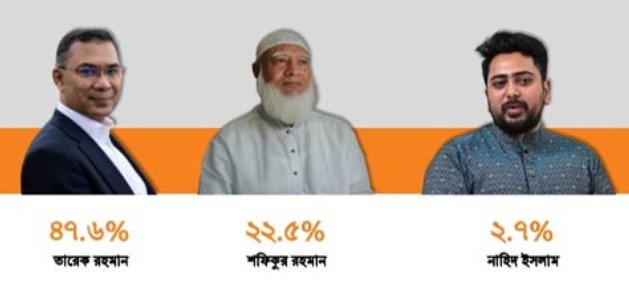
On the prime minister question, 47.6 percent of respondents said they think Tarique Rahman will be the future prime minister. Another 22.5 percent named Shafiqur Rahman, 2.7 percent named Nahid Islam, and 22.2 percent said they did not know who would lead the next government.
Among those who said they have decided their party preference, the BNP and its alliance were projected to secure 52.8 percent of the vote, while Bangladesh Jamaat-e-Islami and its alliance were projected at 31 percent. A further 13.2 percent did not reveal their preference, the survey said.
The report also tried to capture perceived local competitiveness. When asked which party’s candidate could win in their area if elections were held “tomorrow”, 52.9 percent mentioned BNP candidates, while 23.8 percent said they were unsure. Compared to round 2, the mention of BNP as the likely winner increased by 7.5 percentage points in round 3, while Jamaat’s rate rose by 1.1 points, according to the findings.
The survey suggested BNP has been consolidating support by gaining disproportionately from voters who previously stayed undecided or avoided disclosing a choice. Of BNP’s projected vote share among decided voters, 26.6 percentage points came from previously undecided or unrevealed voters, while 14.1 percentage points of Jamaat’s projected share came from that same group, the report said.
The results also point to a shift among previous Bangladesh Awami League voters, a question that has drawn attention since the party was ousted from power in the July uprising and is not expected to participate in the February 12 polls, according to the organisers. The survey report said 32.9 percent of previous Awami League voters are now likely to vote for BNP, 13.2 percent said they may vote for Jamaat, and 41.3 percent remain undecided.
The report further said some supporters who previously backed Jamaat or the National Citizen Party have shifted toward BNP, and that undecided voters are increasingly leaning in the same direction. It also noted that some Jamaat supporters did not express their voting preference, indicating greater instability in Jamaat’s vote bank compared to BNP.
On participation, 93.3 percent of respondents said they plan to vote in February. Among those who had previously said they would vote, 96.1 percent maintained that intention, while 78.5 percent of those who had earlier said they would not vote now plan to participate, the survey said.
The findings also recorded relatively high levels of confidence about the election environment. The report said 72.3 percent believe the government can organise a fair election, 74.4 percent expressed confidence in impartial policing and local administration, and 82 percent said they feel safe about casting their votes.
Alongside the 13th parliamentary election to the Jatiya Sangsad, a referendum on fundamental constitutional amendments as per the July Charter is also scheduled for February 12, the organisers said. The survey found nearly 60 percent of respondents support “Yes” in the referendum, while 22.2 percent said they did not know about the referendum, adding that awareness and opinion vary across demographic and political groups.
A panel discussion was also held at the event.
Dhaka University’s development studies professor Asif M Shahan; Voice for Reform joint convener Fahim Mashroor; BRAIN executive director Shafiqul Rahman; political analyst and BRAIN member Jyoti Rahman; and Innovision portfolio director Tasmiah Rahman, among others, spoke.